

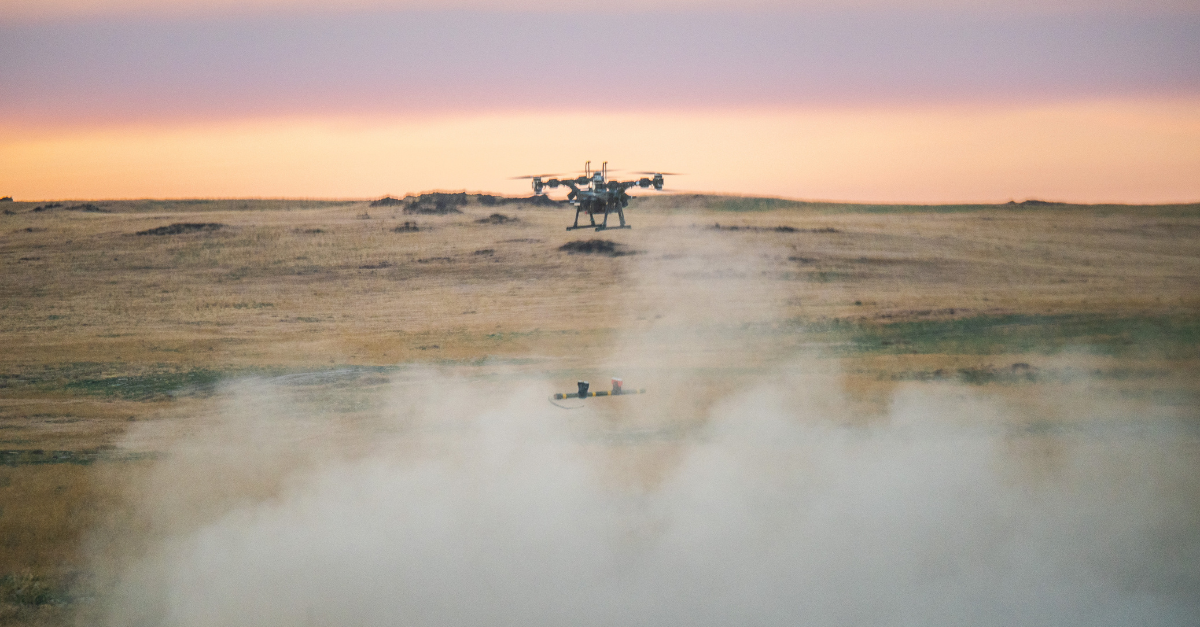
A drone built by an Oregon UAS Accelerator graduate just delivered and detonated a live explosive for the U.S. Army — and the story behind it runs straight through Pendleton.
On June 22, 2026, soldiers with Bravo Company, 741st Brigade Engineer Battalion, Oregon Army National Guard, used a heavy-lift drone to carry and remotely detonate a live Bangalore torpedo against a wire obstacle at Orchard Combat Training Center in Idaho. The platform that made it possible — the Mule 28 — was designed and built by Lorica Technologies of Ashland, Oregon, a proud graduate of the Oregon UAS Accelerator's Spring 2026 Cohort.
This is exactly the kind of outcome the nation's drone industrial base strategy is counting on — and exactly what Oregon has been building toward.
From Cohort to Field-Validated
Lorica Technologies didn't arrive at this moment by accident. When the company joined the Oregon UAS Accelerator's Spring 2026 Cohort, it brought an ambitious vision for autonomous systems — including its SeaSafe platform, an autonomous maritime defense system designed to help commercial vessels detect, deter, and intercept threats. The cohort sharpened that vision into something investable, deployable, and defense-ready.
By the end of the program, Lorica had:
- Placed second in judges' scoring at the Oregon UAS Innovation Showcase, held at the AUVSI Cascade Spring Symposium in Pendleton, April 22–23, 2026
- Led the entire Spring 2026 Cohort in capital raised
- Advanced its Technology Readiness Level from TRL 5 to TRL 6, crossing a critical threshold toward defense and government procurement pipelines
- Grown from 9 to 17 full-time employees — a net gain of 8 jobs during the cohort period
"Participating in the Oregon UAS Accelerator was an excellent experience for our company," said Christopher Dye of Lorica Technologies. "We were able to do deep dives into our business model and explore additional applications for our solutions with a wide range of subject matter experts… We will be fully utilizing the test range in Pendleton over the course of the next few months as we prepare to go to market."
That kind of readiness — technical, commercial, and operational — is precisely what the domestic drone industrial base needs right now.
The Drone That Cleared the Wire
The Mule 28 is not a commercial platform modified for military use. It is a purpose-built, heavy-lift UAS engineered from the ground up for mission-critical applications — exactly the kind of domestically produced, defense-ready platform that federal drone acquisition programs are actively seeking.
Its specs reflect genuine engineering ambition:
- Lift capacity: ~200 pounds
- Airframe: ~45 pounds, powered by eight motors turning 28-inch bi-bladed propellers
- AI processing: 128 trillion operations per second of onboard artificial intelligence
- Communications: Software-defined radios operating across the 0–11 GHz spectrum
- Sensor suite: Facial, vehicle, and weapons recognition; GPS coordinate derivation from camera using trigonometry and focal length
- Swarm capability: Proprietary "HIVE-AS" software enabling natural language drone tasking
On Range 22, the Mule 28 climbed into 25 mph desert winds, carried a live two-section M1A3 Bangalore torpedo to the obstacle, released it, and detonated it — cleanly and successfully. Not a single soldier had to sprint across exposed ground to place the charge.
Why It Matters: A 50% Casualty Problem, Solved by a Drone
The stakes behind this test deserve emphasis. Deliberate breach operations — clearing wire obstacles and minefields to open routes for friendly forces — are among the most dangerous missions in Army engineering. Military doctrine historically plans for 50% casualties among soldiers conducting a deliberate breach.
"The most casualty-producing thing that Army engineers do is the breach," said 1st Lt. Andrew Lucas, who co-led the 741st BEB's drone working group. "If you can deliver something to clear the breach with a $40,000 drone instead of putting soldiers in harm's way, that's worth experimenting with."
The battalion's drone working group was established by commander Lt. Col. Eric Zimmerman, inspired in part by observing the rapid pace of UAS innovation playing out in real-world conflict environments. Crucially, the battalion deliberately chose a domestic manufacturer, citing electronic warfare vulnerability and supply-chain risk as key reasons to avoid foreign-component platforms — a decision that led them directly to Lorica Technologies.
That decision reflects a growing consensus at every level of the U.S. defense establishment: domestic UAS manufacturing isn't just good industrial policy. It's a battlefield requirement.
Building the Domestic Drone Industrial Base — From Oregon
The United States has made its intentions clear. The Pentagon's Drone Dominance initiative reflects a massive, coordinated federal investment in ensuring American forces are equipped with American-built systems — manufactured by American companies, supported by American supply chains, and validated on American soil.
Lorica Technologies is a living example of what that pipeline is supposed to produce. A company with bold technology, shaped through rigorous mentorship and ecosystem engagement, that reached TRL 6, raised private capital, and then went out and proved its platform in a live military demonstration. That is the arc from innovation to procurement readiness — and Oregon built it.
The companies being developed inside Oregon's UAS ecosystem today are the companies that defense programs will be sourcing from tomorrow.
What Comes Next
The Mule 28 demonstration was a proof of concept — but the roadmap ahead is already clear. The 741st BEB will document lessons learned and forward the concept to the broader Army Engineer community, potentially influencing doctrine across the entire force. Lorica is planning next-generation enhancements: refined flight controls, improved dropping mechanisms, and AI-driven autonomous obstacle recognition.
"We're not that far technologically from a drone that has an AI processor on it that could identify where concertina wire is," said Lucas. "You could send it to autonomously deploy the Bangalore on the wire with near-perfect precision, where there's no possibility of it being jammed, because it's all running off of internal direction."